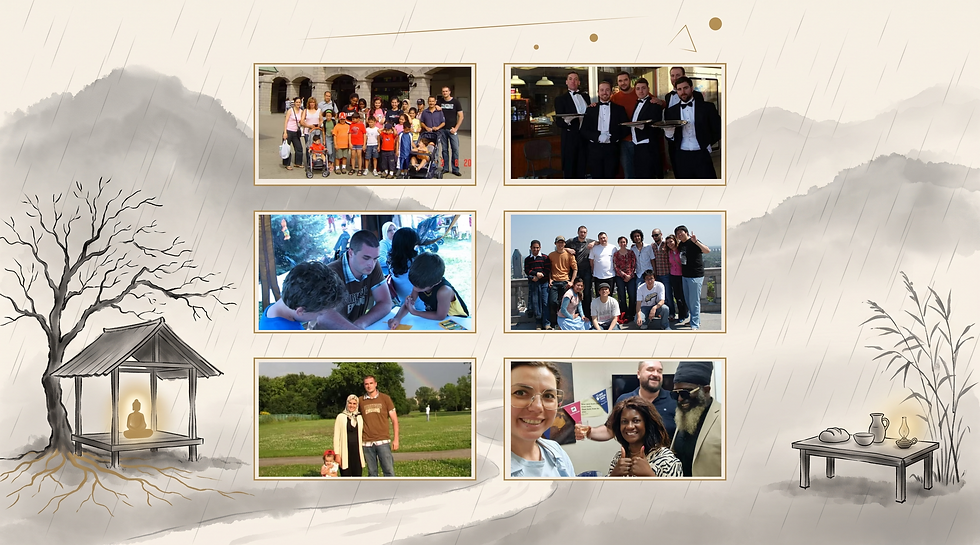


Since 2011, eight hundred households in London have opened their daily lives to the Angel Social Group Butler Service — a welcome into the company of some of the most distinguished houses in London. Service at that height is an education in human beings: in what a life holds, what it hopes for, and what it takes to stand well. It leaves a particular knowledge behind: how far a small, well-placed kindness can carry, and how many lives wait farther from fortune's reach. With that knowledge, and with the inheritance carried by the Group's founder, Iliyan Kuzmanov — a family that served long before it prospered — comes a responsibility that predates any decision, one long known by the quieter name of duty. Some part of a person has always belonged to the world around him. It is the oldest reckoning there is. Cui multum datum. For generations it meant a single thing, work given to the society it stood in, and it reached the present entire, the obligations folded within. So the same craft travels: from the finest addresses in London to those in need, and those the world forgot, for true service keeps to where it is needed most. Work well done leaves something over, and that surplus is held as a kind of trust — turned outward quietly, from within, and never once announced. Gratitude is the plainest name for the drive: gratitude for the welcome, and for the reach it gave. From the first, the Group was built to pay its own way, a sound business before it was ever a good one. What it built was a working model that lived on its own trade and turned its profit outward: commerce made an instrument of good, its gains returned to the lives it set out to lift.


Every long road keeps its sanctuaries — a warm room the traveller enters unasked, and leaves carrying more than they brought to the door. Literature lives by the free hands that keep it — a lamp kept where the way runs hardest, tended for a walker they will never meet. Words and art make a person particular: they bring into a life meaning and purpose, a sense of originality, of thought and act that are one's own, and the quiet certainty of how much a human being matters. Books hold the most sacred corners of our identity, and yet they are made for sharing: light carried from one self into other homes, other selves. For anyone newly arrived in a city, that light is a foothold — the shelf within reach that says, in its quiet way, you may belong here. It says it most to those who come with two suitcases and a language still to master, a whole former life folded into what they remember and what they read. From its earliest years, the Group has held those goods as an inheritance owed to everyone — the wealth of a civilisation, open to whoever reaches for it. A free library is that inheritance given walls and hours: shelves open to all, doors that ask no name, a gift renewed with every morning it unlocks. The first came three years after the first households — in 2014, in London, founded whole by the Group, a free library that was also a community centre. Three thousand volumes stood on its shelves, chosen for the gaps they filled. Behind it stood a larger idea: a self-help centre for London's Bulgarian community, where accounting, legal counsel, and business advice waited for anyone with the will to begin. A person could walk in for a book and walk out with the beginnings of a livelihood. It was the first step. The libraries had begun.



A sanctuary on the road is never only shelves and a roof; it is where the people of a road become a people — where strangers gather around something higher than the day's hunger and rise, together, above the arithmetic of the tribe. A state can weigh the body and assign it a use, but the warmth of one soul turning toward another it can neither issue nor command. A people who tend each other, of their own free will, are the living root a free society grows from. We believe that where every need is met from above, the reaching-out quietly stops — each person kept, and provided for, and alone, content in the way a kept creature is content, and a citizen of nothing at all. So we raise sanctuaries on the road: rooms of light, and the hope of a people free. This one began as a pull before it was ever a plan, stirring in the Group's quieter intentions. It pulled toward Bulgaria, toward the streets and shelves of the founder's early years, toward the traditions that had raised the whole idea of service long before London. Success in London had answered one half of the gratitude; the other half still spoke Bulgarian. There, service came first as a habit of the home the founder grew up in — learned at tables, repeated in small acts, handed on without ceremony. In 2019 the pull became a place: Ezoligentsia, a free library and gathering place, opened in the same spirit as the first. The books had gone home. Walls and shelves a state can provide; the living heat comes from those who burn for the word, and without them the finest reading room stays furniture. From its rooms came the Foundation Art Angel Bulgaria; from its conversations, a platform where politicians and citizens sat at one table; from its example, project after project, cause after cause. So the road keeps its sanctuaries, and the sanctuaries keep the road: free people raising rooms of books for other people on the road, and a free society rising, one sanctuary at a time, from the hands that keep them lit.


.png)
By 2020 the work had outgrown what goodwill could carry, and the Group gave it an instrument: the Foundation Art Angel Bulgaria. It was the first international arm of the Angel Social Group, and it did not arrive alone. Beside it worked Angel Publishing and Angel Analytical — one the pen, the other the compass — so that what the Foundation undertook was written down, examined, and understood. Together they set about one aim: sustainable enterprises on Bulgarian soil, built on the social-business model, profitable enough to endure and steady enough to give. Its design was plain: what the enterprises earned, the causes could spend, with no third hand between them. To carry that design into public life, the Group built its vehicle — the Citizen Platform, a standing forum that drew citizens, civic organisations, figures of influence, and public institutions into one working body around the Foundation's aims. The civic work has run on the Group's own commerce — earned, and spent, by the same house. Freedom of that kind shows in the choosing: rights and dignity, belief and love, and the safety of the vulnerable — each taken for its weight, and held longer than headlines last. This is social business in the strict sense: capital made by enterprise and spent by the judgement that made it — the hand that earns, the hand that gives, and nothing in between. A social business grows only in the soil a society gives it, and that soil, in Bulgaria, had waited a long time for tending. So the Platform went to work in the open, by a method proven small — conversation at three levels, town to nation, projects in place of protests — and the table it set grew long, then longer: through the years its civic work brought it alongside parliamentary and civic partners, the British-Bulgarian Business Chamber, the American Embassy, the United Evangelical Churches and the leaders of the Muslim community, the Norwegian Mechanism and the human-rights causes of its charter. Beside its arms and its vehicle, the Group keeps its tools, and among the sharpest is the journalist Iliyan Kuzmanov — the founder's own pen turned from observation to result, raising awareness and pressing for redress on human rights and the refugee, on domestic violence and the harm done behind closed doors. So the shrines came together, the small and the large that Kuzmanov had set along the road, until every sanctuary answered to one name — Foundation Art Angel Bulgaria.

.png)
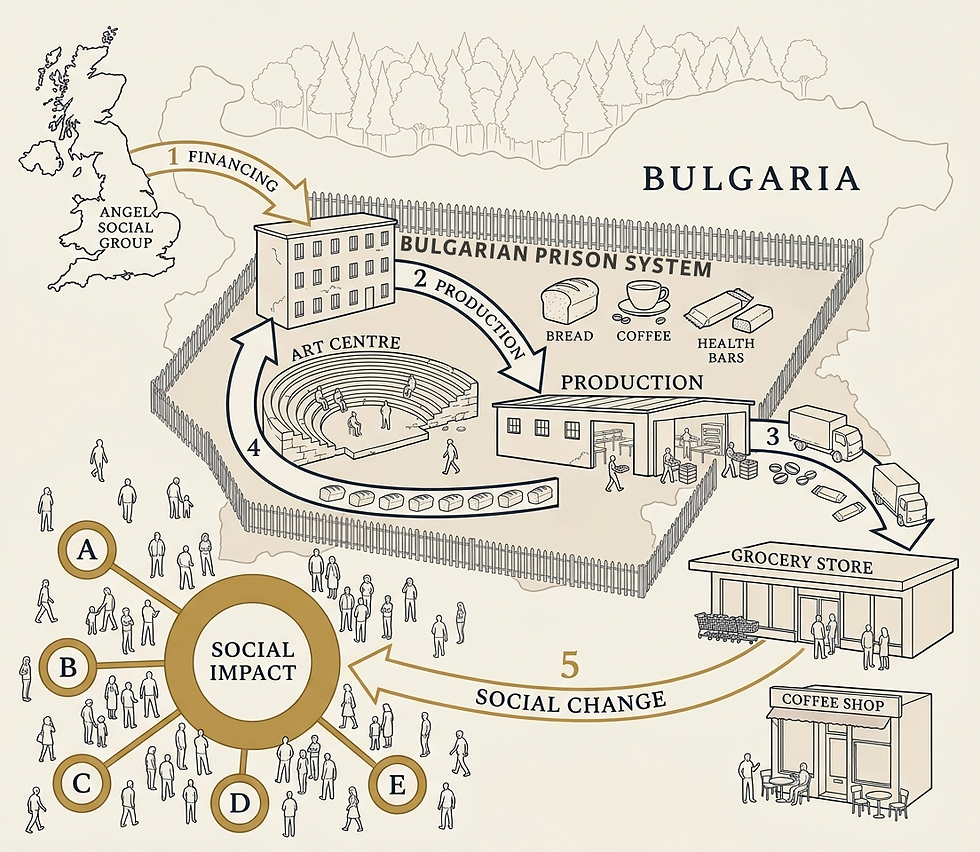
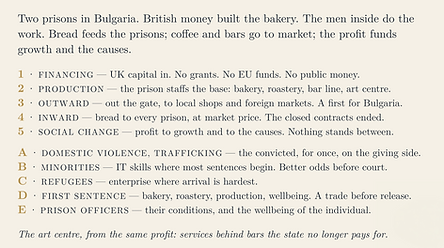
The largest of the Group's undertakings in Bulgaria grew inside the prison system itself, in partnership with the Ministry of Justice. Two prisons were chosen as the pilot — Pazardzhik and Sofia — and behind their walls the whole model was finally asked to prove itself. From one side came the capital of the Angel Social Group; from the other, the Foundation Art Angel, carrying the hearing it had won through the Citizen Platform and the press campaigns of its founder, Iliyan Kuzmanov, by then at the head of a journalists' union. Across production, distribution, and equipment, the project drew leading companies of the trade into partnership. What rose behind the walls was a workshop and more: a production base and a cultural centre together, with rooms for art and acting, and a chapel built for every faith. Its ovens baked bread; its roastery turned coffee; a third line pressed healthy bars. Inward went the bread, to feed every prison in the country, and the sums fell at once. For years, bread and coffee inside the walls had run through closed contracts at prices no open market would set — a practice the press had long since named. A transparent bakery, selling to its own system at honest prices, closed that door without a single speech. Outward went the coffee and the bars, to the open market, and the profit began. Work came first: places on the line for men serving a first sentence, so release would find them with a trade already in hand. Then it travelled back, into the communities where most sentences begin, to build better odds before a courtroom, not after. A share went to the survivors of domestic violence, and the country's arithmetic of blame shifted a degree: the convicted, for once, on the giving side. All that remained was folded back in, so that two pilot prisons would not stay two. Beyond the walls ran a quieter effect: a model transparent to the last loaf, self-sustaining where reliance on European funds had been the custom, proof that what holds in Scandinavia and Britain can root in Bulgarian soil. Under all of it lay the belief the Group was built on: service made person by person, cut to the one life in front of it — its wants, its self — by an artist whose own desire is that expression, multiplied. A household is kept one person at a time; so, it turns out, is a man's way back — the same craft, the same attention, carried into a harder room. In an age of machines and systems, when the answer arrives sooner than the person does, the rarest good is a business with beliefs of its own, money spent on them, and every lev accounted for. Adam Smith gave commerce its founding line in 1776, in The Wealth of Nations: it is not from the benevolence of the butcher, the brewer, or the baker that we expect our dinner, but from their regard to their own interest. Seventeen years earlier, in The Theory of Moral Sentiments, he had written the other half — the fellow-feeling that binds us. The world took the first book and shelved the second. Two and a half centuries on, behind Bulgarian walls, the two shared an oven at last: the baker's interest and the baker's benevolence, rising in one loaf. What the Group believes lives in the person: in the soul and the heart, in the freedom to choose and to speak as oneself, to carry responsibility, and to be kind. Because we live among one another, on a planet that is our home and home to much else alive, and we are, each of us, in one another's keeping.
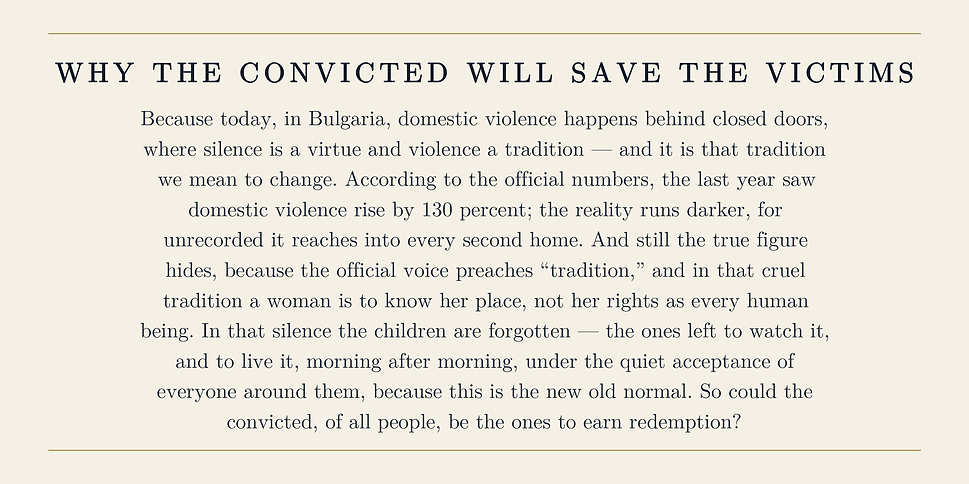



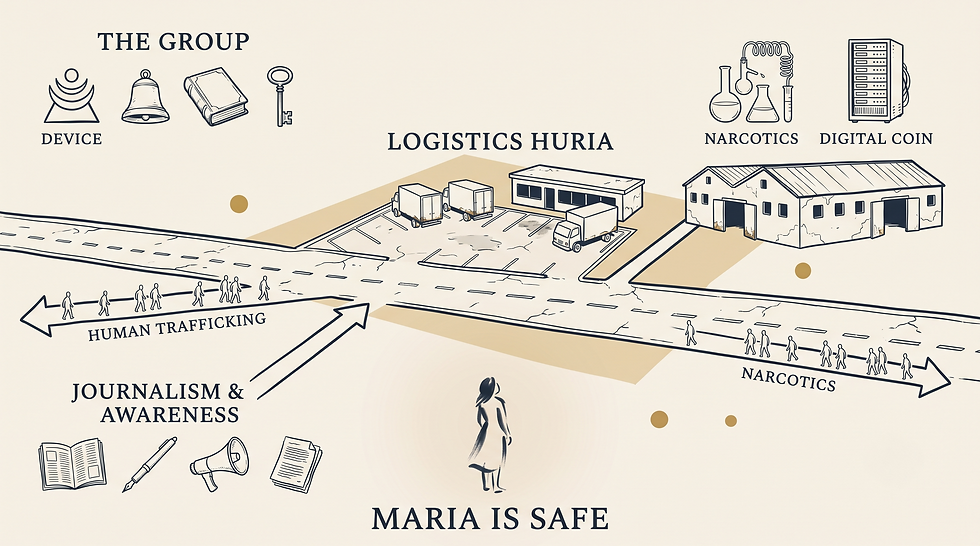
A woman in a headscarf, alone on a back-road in Bulgaria — begin there, because almost no one else would. Some of what crosses that country is not goods but people. The synthetic drugs travel out toward Europe and the people travel back the other way, along one set of roads; a trade of that size and that value does not move without protection, which is bought where it can be. Where public money and European funds flow toward the bodies meant to stop it, some settles into paper charities, and, by the accounts auditors and journalists have drawn, a portion drifts toward the very networks the funding was meant to fight. Project Maria was a trafficking escape taken up when no institution would — the case of a Muslim woman, in a place taught by an old suspicion, lately refreshed, to look past her. The Foundation met it in the open, campaigning where the state fell silent and, behind the noise, seeing her through to safety. Word travelled on its own: Bulgaria first, then the Baltics, Poland, papers across the continent; hundreds of thousands read it. In Kalugerovo the trade lost its machinery — a multi-million-euro operation for synthetic drugs and digital currency destroyed, and a channel for human beings closed. To have seen Maria safe made the Foundation proud; to have told her story aloud made it prouder still, a voice being hard to come by, and rarer still to be seen, where the place you must be saved in is this dangerous. Transparency International has placed Bulgaria at the bottom of the European Union for corruption year after year, and the Organised Crime Index and Europol trace what grows in that soil: a corridor for illicit trade, production lines for synthetic narcotics widening season on season, a waypoint for the opioids bound for European markets. Read together, those measures suggest a harder thing than weakness — that organised crime there works less against the state than, in some measure, through it. And Maria found her sanctuary, one more laid on the road, and safe.



One shrine began the campaign; the questions it opened were older than any single ruin. In a village that still bears the name of a medieval heresy — Bogomil, the dualist faith that rose in tenth-century Bulgaria and reached the Cathars of southern France — stands the Hazar Baba türbe, raised over a dervish among the first to carry his heterodox teaching into Europe. Built to hold a difference of faith, it was, last century, made to vanish: the lodge dissolved into a collective farm, the sanctuary overbuilt, the inscription removed; in the 1980s its community pressed by a regime demanding one identity to surrender even its names. Yet the same state, that same decade, enthroned a heresy as readily as it erased a faith, teaching Bogomilism in its schools as a glory of the early nation — native resistance to Rome, Byzantium, and Ottoman alike. One heterodoxy razed for reading as Muslim, another crowned for reading as anti-Western: usefulness, not principle, decided which past was kept and which unmade. Such is the operation the work uncovers: one persecutory position refilled, regime after regime, by whatever occupant the age requires, a usable past built to carry it. Emptied türbe and broken village crosses are not two grievances but one grammar, activated in turn. Study what was done, and the inheritance surfaces: in the hatreds resurgent across Europe, an old configuration in new vocabulary. Whoever reads a regime-built past carelessly inherits it; where that design has never lifted, to study this ground is not antiquarianism but defence. Read closely, a ruin holds the genealogy of a present danger. So a campaign to save a shrine became a work of scholarship: what a people cannot remember, it is condemned to permit again.
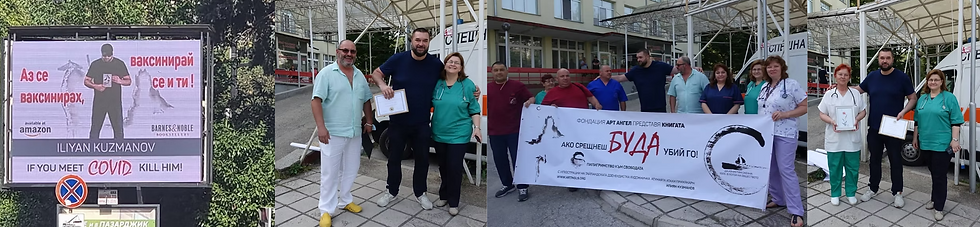
For the Angel Social Group, to serve a client and to serve the society around them were never two acts but one — the outward form of a single belief, that a person is owed attention whether or not they can pay for it. An order is judged, in the end, by what it does for those it finds easiest to overlook; the comfortable need no help to be seen. Mill fixed the principle in 1859, in On Liberty: mankind has no more right to silence one person than that one, empowered, would have to silence all mankind. One against everyone; no other arithmetic serves. Schooled in Canada and Britain, the founder took it early — the single life matters, and is to be defended — and carried it into a country where the law wears thin and the smallest feel it soonest. On Ezo's counter the answer came each morning: free food, coffee, and water for anyone running short, and shelves that sold homeless artists' work and returned each sum to its maker, beside pieces sold for strangers already promised to a hand in need. Where the road turns hardest, Voenna Rampa held the whole system in miniature — a camp where refugee children existed on the books, because the books drew European money, and lived in conditions the press called inhumane, because nothing past the books was ever meant for them. Such is the residue of a bureaucracy that never left, schooled in Soviet years to count people as entries and never otherwise, an inherited habit that keeps the European form while hollowing its substance. Near nine in ten of those children pass through untraced — into trafficking, into prostitution, into the trade in organs — while no office asks. Against it the Group brought care where none was budgeted, means of its own, owed to no fund and no ministry. Minorities held the steadiest place in the work: pathways into work for Roma communities, courses in language and law, workshops where a trade could be learned and then lived from, and beside them the quieter labour against Islamophobia and antisemitism, held at the volume it deserved and no louder. Some of it had to be loud. Billboards rose across the country in 2021 bearing one line — "There is no shame in being gay; the shame is in hating the different" — and in 2024 the civil platform carried that answer to the walls themselves, the national news agency and local officials beside it, meeting the neo-Nazi marks and the slurs where they were written. Through the Foundation Art Angel, the COVID years reached first the emergency rooms of Bulgaria's hospitals, then artists in need, then retired teachers left in poverty. Beneath all of it lie the dignity of the person and a living civil society; and across every cause it took up, the Group turned the plain work of kindness into something like an art.




Every service carries the story it was made from, and the story tells more than the service ever will. To know a craft, find its first morning. In 2005, at the end of a long road, a young stranger reached Montreal with two suitcases and everything he meant to become. What met him from Eastern Europe was a welcome already waiting — La Maison des Parents de Bordeaux-Cartierville, a house whose whole work was immigrant families and their children, whose door opened before it asked a name. Before long he was under its roof, on the project that helped new arrivals' children find their feet, where they played and gathered skills before sharing a word of any language, and their parents found a harbour of art, learning, and play. What Montreal planted stayed: the dream of a service that would be an art larger than self-expression, and it never left the founder of the Angel Social Group. He came of a line that had tended others for centuries; Montreal only gave it a new shape — the rehearsal before London's larger lessons, the city where he read history and worked as a trainer and wellbeing coach, setting new lenses on an old inheritance. From there the best of what he had gathered was drawn to London: in 2011, one company, then eight hundred households, and one butler still after finer ways to serve. Some households asked for more than order, and the calm itself became a craft: company for the mind, care for the body, presence where warmth met the quiet wounds of the soul. London gathered all of it, education and knowledge and care, into one master craft; and the craft refused to stop at service. It researched, it wrote, it filmed, it argued in the press, until, in 2022, national television named its maker among the finest of the modern Bulgarian writers. The road has a claim on whoever walks it, and the old wisdom keeps bread and a lamp for the traveller who may never be met. So shrine, study, and campaign became one instrument — a conviction reaching past the last page of any paper and the last line of any budget, owing its work to no fund and no faculty. The same hand that studied, wrote, built, and campaigned made kindness the house the Group lived in. Tailoring was only ever the apprenticeship; the art was always the gift itself — made with soul and feeling, and meant not merely to shine in the houses it serves, but to change something in the lives that fill them.